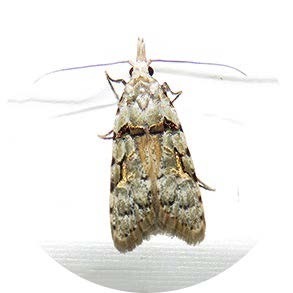
Guava Moth – Coscinoptycha improbana

Available Products
1 mg Standard Lure
Dispenser Details
Natural Rubber Septum
Active Life
4-6 weeks (temperature dependent)
Pest Details
Adult
Wingspan of ca. 15mm. Forewings are off-white with a scattering of grey-brown dots, several dark markings along the costa and a dark sinuate marking that runs across the forewing ca. a third from the front of wing. Males possess a raised tuft of silky white scales towards the base of the wing. Hindwings are white and the body is orange but densely covered in white hair.
Larvae
Larvae are pinkish in colour and reach 5-8 mm in length.
Eggs
Laid in cracks and crevices on susceptible fruit, usually at the stem or style end.
Distribution
Australia and New Zealand
Economic Host(s)
A wide range of fruit and nut trees are attacked. These include guava (Psidium sp.), macadamia (Macadamia integrifolia), plum and peach (Prunus), apple (Malus) and citrus (Citrus sp.).
Symptons/Signs
On hatching larvae burrow into the fruit to feed, leaving a small entrance hole. The larvae continue to feed and develop within the fruit. Signs of infestation include small entrance holes, often with extruding frass and circular brown patches. Infested fruit are inedible and early fruit drop often occurs.On hatching larvae burrow into the fruit to feed, leaving a small entrance hole. The larvae continue to feed and develop within the fruit. Signs of infestation include small entrance holes, often with extruding frass and circular brown patches. Infested fruit are inedible and early fruit drop often occurs.
Generations
Many overlapping generations
Monitoring
Adults Present
All year round
Recommended Trap Density
1-2 traps in large homogenous fruit stands and 3-4 traps per hectare in small mixed fruit crops
Trap Maintenance
Check traps on a regular basis; at least twice a week. We recommend replacing pheromone dispensers every 4 weeks to achieve optimum results. Replace any sticky inserts, if used, when they become filled with dust or insects.
Storage
Keep product away from heat and direct sunlight. Store in a refrigerator for a shelf life of 12 months or a freezer for an extended life of 18 months. Always store sealed in original packaging.
Recommended Trap

Need a solution for this pest?

Before contacting us, please note that we are a manufacturer and producer of pest monitoring solutions.

We do not sell directly to individuals or the public.

Subscribe

* indicates required

International Pheromone Systems Ltd will use the information you provide on this form to be in touch with you and to provide updates and marketing. Please let us know all the ways you would like to hear from us:

You can change your mind at any time by clicking the unsubscribe link in the footer of any email you receive from us, or by contacting us at info@internationalpheromones.co.uk. We will treat your information with respect. For more information about our privacy practices please visit our website. By clicking below, you agree that we may process your information in accordance with these terms.

We use Mailchimp as our marketing platform. By clicking below to subscribe, you acknowledge that your information will be transferred to Mailchimp for processing. Learn more about Mailchimp’s privacy practices here.