0.5mg Standard (G03): Standard lure for monitoring
5mg Longer Life Lure (G03A): A longer life lure for specific requirements
1mg Lure (G03B): A lure with a higher loading for customers that specifically require this
Dispenser Details
0.5mg Standard/1mg Lure: Rubber Septum 5mg Longer Life Lure: Small wax plug
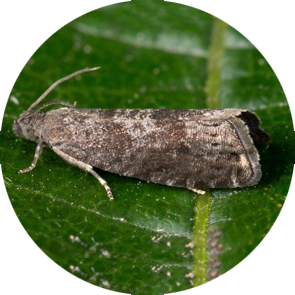
Forewing length of 4-7.5 mm. Forewings are reddishbrown with indistinct silvery-grey markings on the front edge. Hindwings are brown.
Larvae
Early instars are whitish with a black head and prothoracic plate. Late instars reach a length of 9-12 mm. Body bright reddish-pink. Head is dark brown and prothoracic plate is yellowish-brown. The anal plate is pale brown with dark mottling. Anal comb present with 4-10 small teeth
Eggs
Flattened and whitish in colour. Laid singly on young fruit in the first generation and near the base of mature fruit in later generations.
Distribution
Europe, Asia and Algeria
Economic Host(s)
Stone fruits (Prunus spp) including apricot, cherry, peach and plum.
Symptons/Signs
After hatching young larvae bore into fruit to feed on pulp around the stone. Entry holes may be visible and infested fruit may become discoloured and drop early. Gummy liquid may exude from the entrance hole.
Generations
2 – 7 (climate dependent)
Monitoring
Adults Present
May to September
Recommended Trap Density
2 traps per hectare in large uniform orchards and 3-5 traps per hectare in mixed and less dense tree crops.
Trap Maintenance
Check traps on a regular basis; at least twice a week. It is recommended to replace the pheromone dispensers every 4 weeks, if using the Standard or 1mg lure, and
every 7 weeks for the longer life lure, to achieve optimum results.
Replace sticky inserts, if used, when they become filled with dust or insects.
Storage
Keep product away from heat and direct sunlight. Store in a refrigerator for a shelf life of 18 months or a freezer for an extended life of 24 months. Always store sealed in
original packaging.