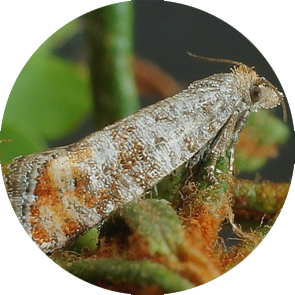
Wingspan of 14-18 mm. Forewings silvery white suffused with grey and thin lines of black. Hindwings are greyfuscous in colour.
Larvae
Final instars reach 9 mm in length. Body is waxy yellowishbrown with very small dark brown pinacula. Head is blackish-brown and prothoracic plate brown.Anal plate is weakly sclerotized and yellowish-brown with some darker mottling.
Eggs
Elliptical, opaque, cream white tinged with red in colour. Laid on pairs of needles beneath bud whorls.
Distribution
Europe and Asia
Economic Host(s)
Pine species.
Symptons/Signs
Newly hatched larvae move to feed on new shoots and spin webs around the needle bases. After initially feeding externally the larvae bore into shoots to feed. The
infested shoots desiccate and drop to the ground. Large infestations may result in death of the crown.
Generations
1
Monitoring
Adults Present
March to June (climate dependant)
Recommended Trap Density
2-4 traps per hectare in large uniform plantations and 4- 6 traps per hectare in less dense or mixed plantations.
Trap Maintenance
Check traps on a regular basis; at least twice a week.
Replace the pheromone dispensers every 4 weeks to achieve optimum results.
Replace sticky inserts once they become saturated with dust or insects.
Storage
Keep product away from heat and direct sunlight. Store in a refrigerator for a shelf life of 18 months or a freezer for an extended life of 24 months. Always store sealed in
original packaging.