Invasive Fruit Fly – Bactrocera invadens

Available Products
Standard 1g Dorsalure-ME Lure (B06A) – Methyl eugenol & proprietary extenders | 2g Methyl eugenol Lure (B06B) – An option for when a 2g version is specifically required e.g. some tenders
Dispenser Details
Large wax plug
Active Life
8-10 weeks
Pest Details
Adult
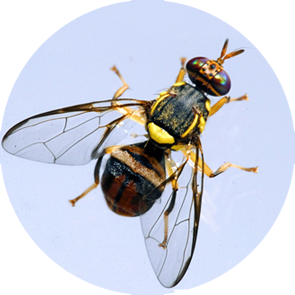
Female: Wings clear except for a narrow costal band that doesn’t reach R4+5. Scutum mostly black, scutellum yellow except for basal band. Abdomen with medial dark stripe on tergites 3-5. Narrow part of cell br with microtrichia and anterior supra-alar setae present. Male: Ocellar triangle black, frons red-brown with fuscous around frontal & orbital setae. Vertex pale-fuscous. Antennae red-brown. Scutum mostly dark orangebrown. Pleural areas dark fuscous to black. Postpronotal lobe yellow. Scutellum yellow except narrow basal band. Femora entirely fulvous. Wing length 5.4-6.9 mm. Tergites 1-5 orange brown and a T shaped pattern on tergites 3-5.
Larvae
Third instar with length of 7.5-10 mm and width of 1.52 mm. Stomal sensory organ of head with 3-4 sensilla. Anterior portion of each thoracic segment with encircling band of rows of small spinules. Anterior spiracles of 8-12 tubules. Posterior spiracles 2.5-3 times as long as broad.
Spiracular hairs just longer than slit.
Eggs
Reticulate, white to white-yellow, 0.8mm long with micropyle slightly protruding. Laid singly below the skin of host fruit.
Distribution
Throughout Africa, Bhutan, India and Sri Lanka
Economic Host(s)
A wide range of fruit and vegetables but is particularly damaging to mango (Mangifera) and guava (Psidium).
Symptons/Signs
Larvae feed internally on fruits. Black or brown lesions can be signs of fruit feeding and exit holes are easily observed.
Generations
Up to 10
Monitoring
Adults Present
February – December (climate dependant).
Recommended Trap Density
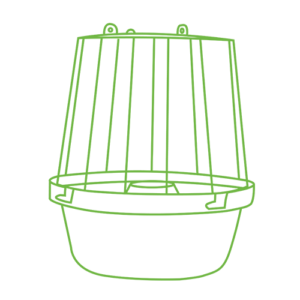
1-2 traps per hectare in large uniform crops and 3-4traps per hectare in mixed or less dense crop stands.
Trap Maintenance
Check traps on a regular basis; at least twice a week. It is recommended to replace the pheromone dispensers every 8 weeks to achieve optimum results.
Storage
Keep product away from direct sunlight, heat, sparks and open flame. Store in a refrigerator for a shelf life of 18 months or a freezer for an extended life of 24 months. Always store sealed in original packaging.
Recommended Trap

Need a solution for this pest?

Before contacting us, please note that we are a manufacturer and producer of pest monitoring solutions.

We do not sell directly to individuals or the public.

Subscribe

* indicates required

International Pheromone Systems Ltd will use the information you provide on this form to be in touch with you and to provide updates and marketing. Please let us know all the ways you would like to hear from us:

You can change your mind at any time by clicking the unsubscribe link in the footer of any email you receive from us, or by contacting us at info@internationalpheromones.co.uk. We will treat your information with respect. For more information about our privacy practices please visit our website. By clicking below, you agree that we may process your information in accordance with these terms.

We use Mailchimp as our marketing platform. By clicking below to subscribe, you acknowledge that your information will be transferred to Mailchimp for processing. Learn more about Mailchimp’s privacy practices here.