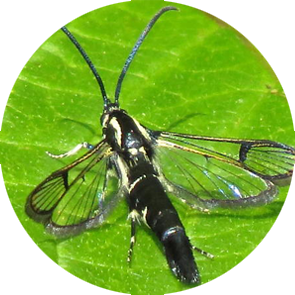
Wingspan of 18-25 mm. Wings transparent with bluishblack scales along margins and main veins. Body is bluish-black with two thin pale-yellow band on the second and markings on the fourth abdominal segments.
Larvae
Mature larvae are 9-25 mm in length. Body is creamy white and the head is yellowish-brown.
Eggs
Oval, brown coloured and less than 1 mm in diameter. Laid singly in cracks or under bark scales of wounded sites on trunks or main branches.
Distribution
North America
Economic Host(s)
Orchard fruit trees, in particular peach, plum and cherry (Prunus).
Symptons/Signs
Larvae feed on living tissue beneath the bark forming galleries between the bark and cambium layer. Larvae enter the trunk at wound sites. Larval feeding increases the size of wound sites causing girdling. Gum containing sawdust or frass and pupal cases in or near exit holes are signs of infestation.
Generations
1-5
Monitoring
Adults Present
April to November
Recommended Trap Density
2 traps per hectare in large uniform stands and 3-4 traps per hectare in heterogeneous or less densely planted orchards.
Trap Maintenance
Check traps on a regular basis; at least twice a week. Replace the pheromone dispensers every 4 weeks to achieve optimum results.
Storage
Keep product away from heat and direct sunlight. Store in a refrigerator for a shelf life of 12 months or a freezer for an extended life of 18 months. Always store sealed in original packaging.