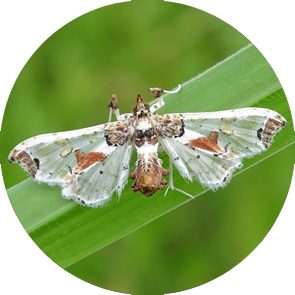
Wingspan of 15-33 mm. Forewings white and slightly transparent with 3 irregular brown blotches. Hindwings with scattered black spots and a brown blotch on transparent to white background.
Larvae
Following hatching larvae are ca. 0.8 mm long, reaching 20 mm when fully grown. Mature larvae are white to pinkish with a brown head.
Eggs
Oval shaped, 0.5 mm in length and 0.3 mm wide. Initially white when laid, darkening with age. Laid singly or in small batches on the calyx or fruits.
Distribution
Central and South America.
Economic Host(s)
Members of the Solanaceae family and Capsicum peppers.
Symptons/Signs
Fruits sized 1-3 cm in diameter are preferentially attacked. Larvae bore into the fruit to feed. Entrance holes are very difficult to see but may be evident as sunken areas with a necrotic spot. Exit holes are larger and more evident, produced when larvae leave to pupate on the ground. Infested fruits drop prematurely.
Generations
2 or more
Monitoring
Adults Present
Most of the year
Recommended Trap Density
Monitoring: 2-3 traps per greenhouse or 3-4 traps per hectare outdoors. Mass Trapping: ca. 20 traps per hectare. Position 12 of the traps on the edge of the crop and 8 in the centre.
Trap Maintenance
Check traps on a regular basis; at least twice a week.
Replace the pheromone dispensers every 4 weeks to achieve optimum results.
Replace sticky inserts, if used, once they become filled with dust or insects.
Storage
Keep product away from heat and direct sunlight. Store in a refrigerator for a shelf life of 18 months or a freezer for an extended life of 24 months. Always store sealed in original packaging.