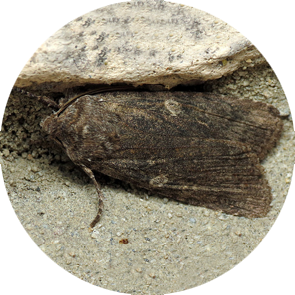
Wingspan of 38-44 mm. Forewings deep blusih-grey with obscure lines. A white to pale grey orbicular spot is most distinct marking with a kidney shaped marking being less conspicuous. Hindwings are pale greyish/brown.
Larvae
Final instars reach 31-37 mm in length. Body is green with a strong lateral yellow to pale stripe. Head and prothoracic plate also green.
Eggs
Hemispherical, ca. 1.5 mm in length, ribbed and greyishwhite in colour. Laid singly on bark of small branches, often near leaf scars.
Distribution
Europe, the Middle East and China
Economic Host(s)
Orchard fruits including apple (Malus), pear (Pyrus), peach and plum (Prunus).
Symptons/Signs
After hatching larvae feed on expanding leaves and buds. Later instars move to feeding on developing fruit clusters.
Generations
1
Monitoring
Adults Present
March-May (climate dependant)
Recommended Trap Density
2 traps per hectare in large uniform orchards and 3-4 traps per hectare in mixed and less dense tree crops.
Trap Maintenance
Check traps on a regular basis; at least twice a week. It is recommended to replace the pheromone dispensers every 4 weeks to achieve optimum results. Replace sticky inserts when they become filled with dust.or insects.
Storage
Keep product away from heat and direct sunlight. Store in a refrigerator for a shelf life of 18 months or a freezer for an extended life of 24 months. Always store sealed in original packaging.