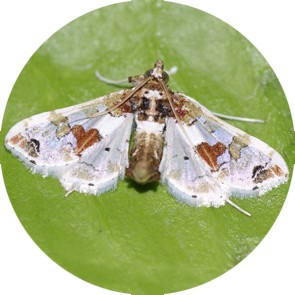
Forewing length of 8.5-10.5 mm in males and 9.5-12 mm in females. Forewings with white ground colour, a brown basal area delimited by a dark brown to grey medial line.
The median area has a pale brown stigma reaching from the costa to the centre of the forewing. A prominent orange to dark brown L shaped or triangular spot leads to the centre of the forewing and often meets the stigma.
Larvae
Newly hatched larvae are ca. 1 mm long with a dark brown to black head and pale pink to off-white abdomen.
The pink colour darkens with age. Final instars reach 18 mm in length, are a strong pink colour with a pale brown head and pale brown spots along the body.
Eggs
Oval, white to cream coloured, ca. 1 mm long. Laid singly or in small batches on the underside of leaves.
Distribution
Sub-Saharan Africa, the Middle East and Asia.
Economic Host(s)
Aubergine and to a lesser extent potato and tomato
Symptons/Signs
Early instars may bore into shoots causing wilting and dieback. Larvae typically bore into fruits below the calyx to feed on the pulp. Entrance holes may become filled with frass. Exit holes are much larger and more obvious.
Generations
Up to 9 (climate dependent)
Monitoring
Adults Present
March to October (Climate dependant)
Recommended Trap Density
Glasshouses: 2-3 traps per glasshouse. Outside: 2-3 traps per hectare in large uniform areas of crops and 3-5 traps per hectare in less dense or mixed crop stands.
Trap Maintenance
Check traps on a regular basis; at least twice a week.
Replace the pheromone dispensers every 4 weeks to achieve optimum results.
Replace the sticky inserts, if used, when they become filled with dust or insects.
Storage
Keep product away from heat and direct sunlight. Store in a refrigerator for a shelf life of 18 months or a freezer for an extended life of 24 months. Always store sealed in original packaging.