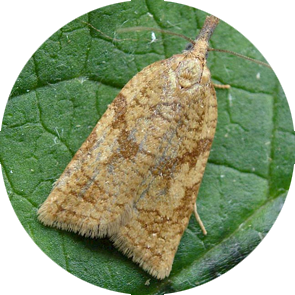
Wingspan of 20-25 mm and a body length of 10-15 mm. Forewings straw yellow with 3 reddish-brown transverse bands that may be broken or merged. Hindwings uniformly grey with long fringes. Head is brown with forward projecting labial palps.
Larvae
Final instars reach 30 mm in length. Body is greenishgrey to dirty green, paler underneath with pale pinacula. Head and prothoracic plate are dark brown.
Eggs
Flat and oval, yellowish-green when first laid, becoming orange-yellow with age. Laid in raft like batches on the upper surface of leaves.
Distribution
A range of plants including hop (Humulus), vines (Vitis), apple (Malus), pear (Pyrus) and strawberry (Fragaria).
Economic Host(s)
Olive
Symptons/Signs
After hatching larvae move to bark crevices and other hidden sites to hibernate. In the following spring larvae feed on buds and young leaves, webbing them together
with silk. Branches and leaf peduncles of vines are also attacked causing leaves to dry up and turn red.
Generations
1-2
Monitoring
Adults Present
July to August
Recommended Trap Density
Attached to a tree branch, stake or other supportive structure at a height of ca. 1.5-2 m in trees or 1 m in other crops. Traps can be hung from wire supports in vines.
Trap Maintenance
Check traps on a regular basis; at least twice a week. It is recommended to replace the pheromone dispensers every 4 weeks to achieve optimum results.
Replace sticky inserts, if used, once they become saturated with dust or insects.
Storage
Keep product away from heat and direct sunlight. Store in a refrigerator for a shelf life of 18 months or a freezer for an extended life of 24 months. Always store sealed in
original packaging.