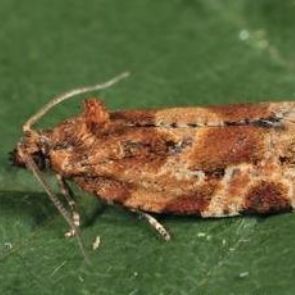
Wingspan of 12-16 mm. Forewings silvery grey to pale brown with dark red-brown markings. Hindwings grey with whitish cilia.
Larvae
Length up to 18 mm. Body yellowish green with pale, indistinct pinacula. Head yellowish green to pale green and prothoracic plate mainly pale green. Anal plate pale
green often speckled black.
Eggs
Lemon yellow when laid, turning light brown. Laid in clusters on the underside of leaves.
Distribution
Western Europe and Asia.
Economic Host(s)
A range of fruit trees and shrubs, including grape (Vitis), apple (Malus), pear (Pyrus), raspberry (Rubus) and gooseberry (Ribes).
Symptons/Signs
Early instars feed on developing buds while later instars move to feed on leaves and young fruit in the shelter of rolled leaves.
Generations
2-3
Monitoring
Adults Present
April to May and June to July
Recommended Trap Density
1-2 traps per hectare in large uniform stands and 2- 4traps per hectare in heterogeneous and less dense stands.
Trap Maintenance
Check traps on a regular basis; at least twice a week. Replace the pheromone dispensers every 4 weeks to achieve optimum results.
Replace the sticky inserts, if used, when they become filled with dust or insects.
Storage
Keep product away from direct sunlight, heat, sparks and open flame. Store in a refrigerator for a shelf life of 18 months or a freezer for an extended life of 24 months.
Always store sealed in original packaging.