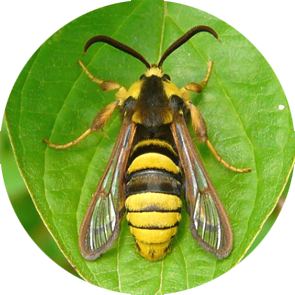
Wingspan of 33-48 mm. Forewings with transparent scales and brown veins. Body black and yellow. Abdomen striped with yellow bands. Tegulae and head also yellow.
Larvae
Final instars reach 30-40 mm in length. Body is creamy white with a red-brown head and a yellowish prothoracic plate.
Eggs
Laid near the base of the trunk of the host plant.
Distribution
Europe, Asia and North America
Economic Host(s)
Poplar tree species.
Symptons/Signs
Larvae bore into the cambial layers and outer wood of the lower parts of the trunk, producing extensive galleries. Sawdust and frass may be visible near the entrance holes and pupal cases are often left at exit holes. Woodpeckers further damage trees by digging for the larvae.
Generations
1
Monitoring
Adults Present
June to July (climate dependant)
Recommended Trap Density
2 traps per hectare in large uniform areas of susceptible trees and 3-4 traps per hectare in less dense or mixed tree stands.
Trap Maintenance
Check traps on a regular basis; at least twice a week. Replace the pheromone dispensers every 4 weeks to achieve optimum results
Storage
Keep product away from heat and direct sunlight. Store in a refrigerator for a shelf life of 18 months or a freezer for an extended life of 24 months. Always store sealed in original packaging.