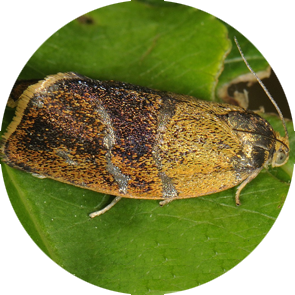
Wingspan of 15-20 mm. Forewings are blackishbrown suffused with greenish-gold and metallic silver markings.Hindwings are black-brown with a paler anterior margin
and pale fringe.
Larvae
Mature larvae reach 20 mm in length. The body is bluishgreen above and pale yellow-green below with a dark line along the back and dark lines on each side. Head is
yellowish-brown to black and prothoracic plate is pale yellow to yellowish-brown marked black on each side.Thoracic legs are black.
Eggs
Oval and flat, ca. 1 x 0.7 mm in size and pale green in colour.
Distribution
Europe and parts of Asia.
Economic Host(s)
A range of trees including oak, hazel, poplar, sycamore, willow, fir and larch
Symptons/Signs
Young larvae feed on foliage before hibernating through the winter. They re-emerge in the spring to feed on opening buds and young foliage. Final instars feed on
foliage within rolled leaves.
Generations
1
Monitoring
Adults Present
June to July (climate dependant)
Recommended Trap Density
2 traps per hectare in large dense plantations or 3-4 traps in small low density or well spread plantations.
Trap Maintenance
Check traps on a regular basis; at least twice a week. Replace the pheromone dispensers every 4 weeks to achieve optimum results.Replace the sticky inserts once they become saturated with dust or insects.
Storage
Keep product away from heat and direct sunlight. Store in a refrigerator for a shelf life of 18 months or a freezer for an extended life of 24 months. Always store sealed in
original packaging.