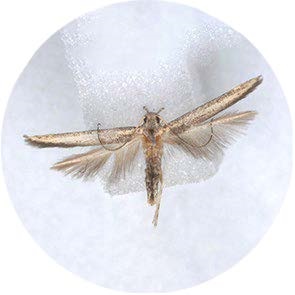
Wingspan of 11 – 14 mm. Forewings are clothed in brown scales and lanceolate shaped. The hindwings are grey with long fringes.
Larvae
Larvae reach 8-12 mm in length and are white-grey in colour with a pale brown head and thorax. The prolegs are present on segments 3, 4 and the apical segment.
Eggs
Small and pale yellow in colour, laid singly or in small batches on flowers and immature fruits.
Distribution
North Africa, the Middle East & Western Asia
Economic Host(s)
The Date Palm, Phoenix dactylifera
Symptons/Signs
Larvae feed on developing fruits. The first generation typically feeds within the flowers. Silken webbing is used to attach fruit to plant strands of other fruits and larvae
feed within the woven shelter. The last generation diapause as adults until the following April.
Generations
3
Monitoring
Adults Present
April to August (climate dependant)
Recommended Trap Density
2-3 traps per hectare depending on crop size and topography. More traps are required in small heterogenous crop stands and in hilly terrain.
Trap Maintenance
Check traps on a regular basis; at least twice a week. It is recommended to replace the pheromone dispensers every 4 weeks to achieve optimum results. Replace the
sticky inserts when they become filled with dust or insects.
Storage
Keep product away from direct sunlight, heat, sparks and open flame. Store in a refrigerator for a shelf life of 18 months or a freezer for an extended life of 24 months.
Always store sealed in original packaging.