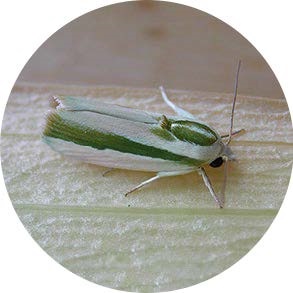
Wingspan of 17-23 mm. Forewings creamy white to peach with a central green wedge running near to the distal edge.
Larvae
Length of final instar reaches 13-18 mm. Body pale brown tinged with grey to green, pale along the mid dorsal line and suffused yellow ventrally.
Eggs
Spherical, sky blue, 0.5 mm in diameter and sculptured.
Typically laid on young bolls, shoot tips and buds.
Distribution
Sudan, southern Asia and Australasia.
Economic Host(s)
Cotton (Gossypium), okra (Abelmoschus) and tomato (Lycopersicum)
Symptons/Signs
Larvae bore into terminal buds to feed on soft growing stages. Extensive tunnelling results in wilting of the top leaves and collapse of the top of main stems. Stem
apexes turn black and die. Buds and flowers wither and drop. Conspicuous holes are present where the larvae entered.
Generations
Up to 6
Monitoring
Adults Present
All year round in warmer climates.
Recommended Trap Density
1-3 traps per hectare in large uniform crop stands and 3- 4 traps per hectare in less dense mixed crop stands. Position traps ca. 50m apart.
Trap Maintenance
Check traps on a regular basis; at least twice a week. It is recommended to replace the pheromone dispensers every 4 weeks to achieve optimum results.
Replace sticky inserts, if used, when they become filled with dust or insects.
Storage
Keep product away from heat and direct sunlight. Store in a refrigerator for a shelf life of 6 months or a freezer for an extended life of 12 months. Always store sealed in
original packaging.