Wingspan of 18-28 mm in the male and 27-39 mm in the female. Forewings are yellowish-brown to brown with numerous narrow brown lines running across the length
of the wing. Hindwings are off-white in the males and paler white in females.
Larvae
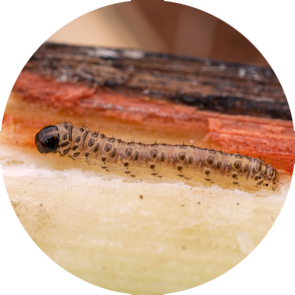
Two forms exist: a summer form and a winter form. The summer form are whitish with a brown head while the winter form also has large brown spots present on each
segment (pinacula) each bearing a bristle. When fully grown they reach ca. 30 mm in length.
Eggs
Flattened and oval, ca. 1.16 mm in length, initially white but turning orange with age. Laid in clusters of 2 to 50 overlapping eggs on both sides of the leaf.
Distribution
Warmer parts of North America. Also Central America, South America and the Caribbean.
Economic Host(s)
Primarily a pest of sugarcane but will also infest maize, rice and sorghum.
Symptons/Signs
Early larval instars feed on leaf tissue and leaf midribs. After moulting larvae burrow into stalks to feed. In young crops feeding damage results in “dead hearts”, where the growing point of the plant may be killed and growth stunted. In more mature crops larval feeding causes the tops to die and often break off. Larvae may also burrow into ears to feed.
Generations
Up to 5 (climate dependent)
Monitoring
Adults Present
April to October
Recommended Trap Density
2-3 traps per hectare in large open homogenous crop stands. Use more traps in small or heterogenous crop stands.
Trap Maintenance
Check traps on a regular basis; at least twice a week. It is recommended to replace the pheromone dispensers every 4 weeks to achieve optimum results.
Replace sticky inserts, if used, when they become filled with dust or insects.
Storage
Keep product away from heat and direct sunlight. Store in a refrigerator for a shelf life of 6 months or a freezer for an extended life of 12 months. Always store sealed in
original packaging.