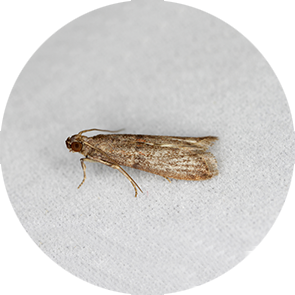
Wingspan of 16-30 mm. Forewings grey with indistinct darker markings. Labial palps short and curved upwards.
Larvae
Length of 15-20 mm. Body a white to pink colour with darker pinacula. Abdominal segment 8 has SD2 separated from spiracle by horizontal width of spiracle.
Also the posterior bristle D2 is 2-2.5 times as long as anterior bristle D1 on abdominal segments 1 to 7.
Eggs
White and sticky, laid amongst a suitable food source.
Distribution
Cosmopolitan, but more common in tropical regions.
Economic Host(s)
A wide variety of stored products including cereals, dried fruits, nuts and cocoa beans.
Symptons/Signs
The larvae feed within silken tunnels, binding grain and other foodstuffs together. Signs of feeding include silk webbing, frass, caste skins and pupal cases.
Generations
2-6
Monitoring
Adults Present
All year round
Recommended Trap Density
Traps should be placed 10-15 m apart. Once the location of an outbreak has been established, traps can be moved closer together in this area or more traps added.
Trap Maintenance
Check traps on a regular basis; at least twice a week. It is recommended to replace the pheromone dispensers every 4 weeks to achieve optimum results.
Replace the sticky inserts, if used, when they become filled with dust or insects.
Storage
Keep product away from heat and direct sunlight. Store in a refrigerator for a shelf life of 12 months or a freezer for an extended life of 18 months. Always store sealed in
original packaging.